Isenberg Expands AI Education Across Programs, Classrooms, Career Prep, Research
Artificial intelligence (AI) is no longer a niche skill set. It’s become a baseline expectation in business—showing up in in how teams analyze data, forecast demand, personalize customer experiences, manage risk, strategize, and make decisions at speed. At the Isenberg School of Management at UMass Amherst, that shift has shaped a priority: ensuring students and working professionals are prepared to lead in an economy where AI is everywhere.
“For business schools, equipping students with the skills to effectively and ethically harness AI is no longer optional but essential,” said Nikunj Kapadia, PhD, Isenberg’s associate dean of graduate programs. “As AI reshapes the workplace, the Isenberg curriculum ensures that our graduates are prepared to navigate and lead in an evolving business landscape.”
New AI Credentials for Undergraduates and Graduate Students
A milestone came with the launch of Isenberg’s first AI-dedicated certificate programs: the Artificial Intelligence in Business Undergraduate Certificate and the Graduate Certificate in Artificial Intelligence for Business. While Isenberg has offered coursework on business applications of machine learning for over a decade, the new certificates significantly broaden and integrate AI-focused content across all business disciplines.
The undergraduate certificate is a five-course program that provides foundational knowledge in AI alongside elective options exploring how AI is applied in business contexts—including professional communication, productivity, service offerings, machine learning, and ethical considerations.
Meanwhile, the graduate certificate is a 12-credit, fully online program designed for professionals who want to build fluency in AI principles, tools, and business applications. It covers topics such as machine learning, generative AI, strategy, and the ethical and legal challenges associated with AI adoption.
Together, these programs reflect Isenberg’s strategy: provide structured pathways for learners to build AI capability—without losing sight of the real work of business, where technical literacy must translate into better decisions, better leadership, and better outcomes.
Making the MBA Curriculum “AI-fluent”
Beyond stand-alone credentials, Isenberg has been integrating AI concepts and tools across the core curriculum of its MBA program—so students encounter AI not as a single topic, but as a practical lens across disciplines such as accounting, operations, marketing, information systems, and statistics.
“We put our curriculum under the microscope and looked for every opportunity to expose students to AI tools and techniques, enhancing their learning and better preparing them for workplace demands,” said Kapadia. “This effort parallels the efforts in the wider business community across the world in reimagining workplace processes.”
For Monideepa Tarafdar, PhD, the Charles J. Dockendorff Endowed Professor in Information Systems, that means helping future leaders become smart, discerning users of AI, especially as organizations move from experimentation to sustained adoption.
“We’re still at the beginning of real adoption of AI,” she said. “We need to use it repeatedly to gain confidence in the decisions AI is making.”
Tarafdar’s assignments encourage students to use generative AI intentionally and then compare AI-heavy work with work that relies primarily on their own reasoning, helping them recognize both the value and limits of AI outputs.
Albert Assaf, PhD, graduate faculty director, teaches statistics and economics. He is incorporating AI tools to generate real-world data scenarios, create practice problems at varying levels of difficulty, and explore how AI can help with interpretation, coding, and statistical reasoning.
“More broadly,” he said, “I see Isenberg’s AI curriculum evolving in a very positive direction, with increasing integration of AI literacy, applied analytics, and ethical considerations across core and elective courses.”
Isenberg’s leadership in AI also includes faculty research on how AI is changing work. Marta Stelmaszak Rosa, PhD, assistant professor in operations and information management, studies how AI systems often depend on hidden human input—redistributing work rather than replacing it.
The takeaway for leaders and students? AI still needs people who can interpret results, ask strong questions, and responsibly manage human-AI collaboration.

Ethics, Law, and Responsible AI Use
Isenberg’s approach to AI also emphasizes that readiness is not just about technical proficiency. It’s also about the judgment required to navigate the ethical, legal, and societal challenges AI can introduce, such as algorithmic bias, data privacy, and the human impacts of automation.
To support that preparation, Isenberg faculty have developed AI ethics curricula, including a new “AI and Ethics” course for business students.
“We need to prepare students for a work environment where the use of AI is widespread,” said Jennifer Merton, JD, associate chair and senior lecturer in Isenberg’s Management Department, who leads business ethics initiatives in the school and co-developed the curriculum.
AI Skill-building Beyond the Classroom: Badges and Micro-learning
In addition to academic courses, Isenberg has expanded skill-building opportunities that students can complete on a flexible schedule and showcase professionally. One example is the “DataCamp AI Business Fundamentals Skills Track,” which is available to undergraduate and graduate students (as well as to faculty and staff). The track includes short courses (about 11 hours total) that introduce topics like ChatGPT, large language models, AI strategy, AI ethics, and implementing AI solutions in business.
Once students complete the training, they receive a badge that they can post on LinkedIn and display their credentials to recruiters and employers.
AI Meets Immersive Learning: VR Interview and Presentation Practice
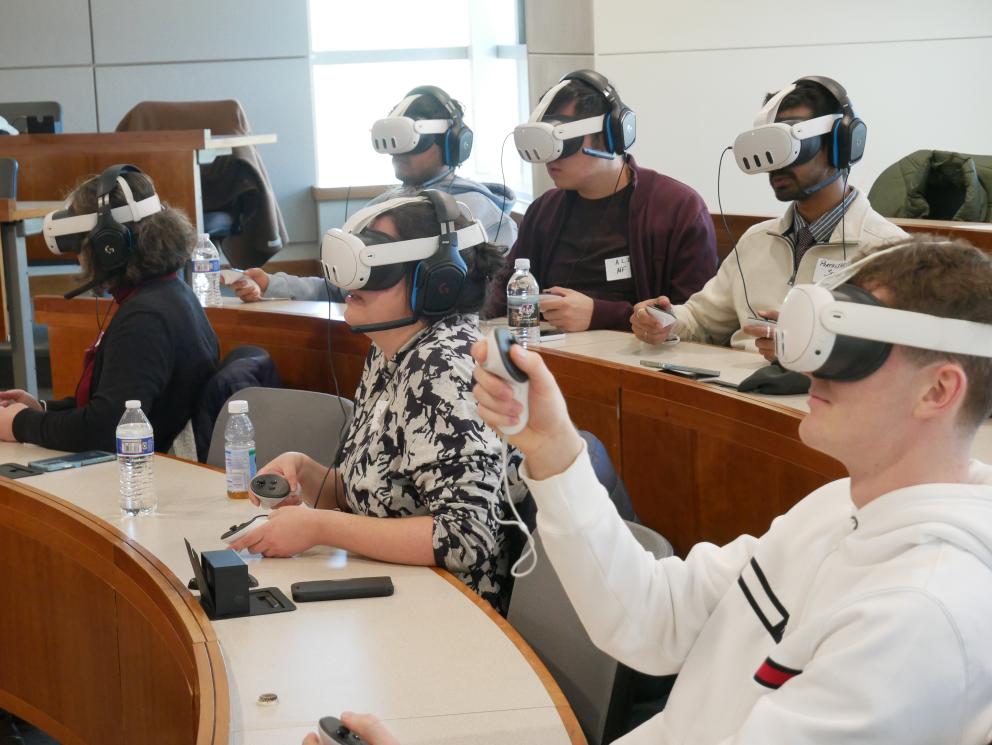
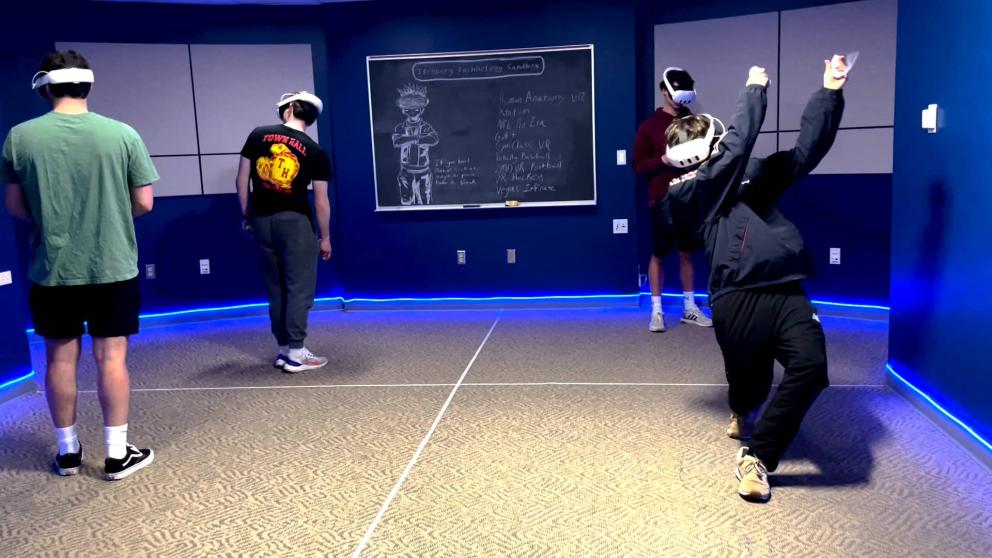
Isenberg is also pioneering the use of generative AI in virtual reality (VR) to help students sharpen their interviewing skills for finance careers. Finance lecturer Jeffrey Robert, PhD, alongside Chris LaPointe, learning and research technology coordinator for the TRAIN (Teaching, Research, And Innovation Nexus) team, designed a cutting-edge simulation embedded within a finance course that equips students to practice interviews for Wall Street positions through immersive VR interactions.
The idea emerged during a technology learning session hosted by Susan Boyer, Isenberg’s director of instructional technologies. The initiative leverages VR headsets and VirtualSpeech software, enabling students not only to respond to AI-generated interview questions but also to engage with dynamic follow-up questions, a feature that sets this simulation apart from typical interview prep activities. The AI listens and adapts in real time, deepening the realism of the experience for finance interview scenarios.
“Our goal was to create an environment that mirrors the unpredictability and rigor of real finance interviews,” said Robert. “By training the AI model specifically for Wall Street finance roles, the simulation provides authentic practice that challenges our students to think on their feet.”
Students reported overwhelmingly positive experiences with the simulation, praising its interactivity and relevance. Many expressed eagerness to use this tool again to bolster their interviewing confidence and skills.
The TRAIN team, which supports initiatives across the Berthiaume Behavioral Research Lab, Isenberg Technology Sandbox, ISucceed program, Video Production Studio, and various teaching tools, was instrumental in developing and deploying this innovative learning experience.
“Collaborations like this demonstrate how technology integration elevates teaching and research—bridging theory and practice in meaningful ways,” said LaPointe.
This VR AI interview simulation represents a transformative step in professional preparation for business students, positioning Isenberg at the forefront of technology-enhanced education.
Preparing Graduates to Lead in an AI-shaped Economy
Isenberg’s direction is clear: Students shouldn’t graduate merely familiar with AI; they should be able to apply it thoughtfully, ethically, and effectively across business functions, while understanding its risks and human consequences.
As Kapadia emphasized, Isenberg’s goal is to prepare learners for leadership in a world where AI is transforming modern work—not someday, but now.
