Isenberg Business Communication Course Blends VR, AI, with Real-World Experience
In today’s workplace, professionals are expected to do more than write well and deliver polished presentations. Employers want them to collaborate across cultures and time zones, navigate emerging technology, evaluate information, strategize marketing plans, and responsibly use artificial intelligence (AI).
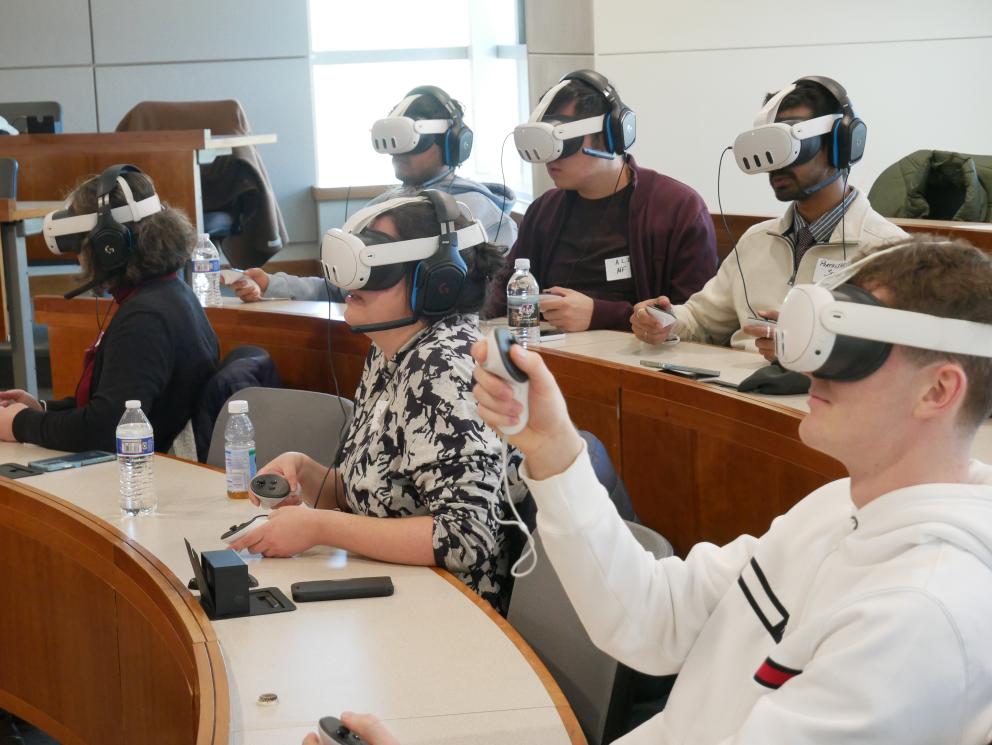
At UMass Amherst’s Isenberg School of Management, students are gaining experience with those expectations through a custom-designed Business Communication 310 course section that combines real-world, client-focused projects, custom virtual reality (VR) experiences as well as a structured and ethical approach to AI.
Across the Isenberg academic curriculum, faculty seek to narrow the distance between the classroom and the workplace. VR helps them do that, according to Robert Bowse, director of Isenberg’s Business Communication Program.
“VR technology gives students a safe but realistic environment to practice communication, make decisions, experience the consequences of those decisions, and try again,” he said. “The technology is exciting, but, ultimately, this isn’t about VR—it’s about preparing students to communicate confidently, thoughtfully, and effectively in situations they’ll actually encounter in their careers.”

Business Communication Senior Lecturer Kerry O’Grady, EdD, took that goal a step further by envisioning a cross-cultural communication simulation that reflects today’s global workplace.
“I kept hearing from students that they were excited—but also nervous—about studying abroad,” she said. “At the same time, working on remote, international teams is becoming the norm in business. When the opportunity arose to create a custom module, I immediately began working on a cross-cultural communication experience.”
O’Grady’s custom-designed simulation places students in the role of an employee tasked with leading a virtual meeting involving colleagues from multiple countries and time zones. Drawing on course readings and communication strategies, students (while wearing Isenberg-supplied VR headsets) navigate cultural differences while planning and facilitating the meeting before receiving feedback on their performance.
“Learning by doing—and productive failure—is a major part of my pedagogy,” said O’Grady. “I can teach cross-cultural communication until I’m blue in the face, but it’s not an effective experience if students don’t get to live in and apply what they’ve learned.”
For Catherine Saladino, a junior accounting major who took O’Grady’s course last semester, the technology offered an opportunity to put classroom concepts into practice.
“The VR experience was unique and allowed me and the other students in the class to apply what we learned in class in a ‘real-world’ setting,” she said.
Andrew Gonzalez, a junior finance major, said using the VR simulation was intimidating at first. “But it trained me to think on my feet, structure my answers under pressure, and stay composed, which is exactly what a real interview demands,” he added.
Teaching Students to Responsibly Use AI
While many colleges continue debating how AI should fit into the classroom, Isenberg’s direction is clear: Students shouldn’t graduate merely familiar with AI; they should be able to apply it ethically and effectively across business functions, while understanding its risks and human consequences. O’Grady has embraced a structured approach that reflects employer expectations while maintaining academic integrity.
Her course materials are direct: “The business world expects you to use AI to enhance your thinking; not replace it. And that’s exactly what we’ll learn how to do here.”
Rather than prohibiting AI or allowing unrestricted use, O’Grady’s approach to it is strategic and data driven. Students start the semester with training in AI fundamentals and prompting. Throughout the semester, they use AI only for designated purposes: brainstorming, outlining, presentation design, and feedback. Every use must be documented, with prompts cited and outputs verified for accountability.
“I was an early adopter of AI and quickly saw its value in the professional world,” said O’Grady. “Employers expect graduates to know how to use it well, starting with effective prompting, and to use it to save time on lower-level tasks so they can focus on uniquely human thinking.”
At the same time, O’Grady emphasizes that AI should never replace critical thinking.
“’Garbage in, garbage out’ still applies,” she said. “Without proper prompting and strategic intent, AI often produces average work. Students need to learn how to evaluate outputs critically, verify information, and use AI ethically.”
Stella Lunati, a junior operations and information management major, said O’Grady’s approach helped her understand the difference between using AI as a professional tool and allowing it to take over one’s work.
“AI is becoming such a significant part of school and the professional world, and students are going to encounter it, whether they’re prepared for it or not,” said Lunati.
O’Grady said she believes AI skills are becoming just as important as traditional writing instruction.
“My boundaries are for their own good because how I approach AI in my classrooms is how students will be expected to use it in real life,” she said. “If AI can do the thinking for them, then they won’t develop the skills employers are actually hiring for.”
Real Clients and Challenges
O’Grady’s immersive approach extends beyond VR and AI. For their final project last semester, student teams worked with an actual business client to solve a real communication challenge. After conducting client meetings, researching the problem, and developing data-driven recommendations, each team delivered a seven-minute pitch to the client, who selected the proposal they believed best addressed the organization’s needs.
“Students are thrown into the deep end of true business challenges, client relationships, and sophisticated problem solving,” said O’Grady.
Frankie Capaccio, a senior finance major, said the team-based structure helped prepare him for the collaborative nature of the modern workplace. He said he saw the value of that experience firsthand during his internship this summer.
“Reaching out to clients and businesses seems easier, I understand how my team functions and what I can do to improve it, and talking aloud in meetings and important conversations is now easier for me, all because of this class,” he said.
A Classroom That Mirrors the Office
Saladino said the course’s emphasis on collaboration, accountability, and participation proved valuable when she began a public accounting internship this summer.
“Entering the workplace on the first day in a high-stakes environment, I was surprisingly calm,” she said. “I felt comfortable advocating for myself, and—most importantly—I felt confident in how I communicated with my peers and the professionals at the firm.”
Lunati had a similar experience during her internship this summer at a manufacturing company, where she worked with colleagues from different backgrounds, cultures, and experience levels. She found herself returning to O’Grady’s lessons about how body language, facial expressions, and other nonverbal cues can affect communication across cultures.
“I found myself thinking back to those VR lessons while navigating real workplace situations,” said Lunati. “I genuinely feel that Professor O’Grady’s class gave me a better foundation for understanding and handling those interactions.”
O’Grady hopes those lessons continue to serve students long after their internships—and their time at Isenberg—are over.
“Five, 10, or 20 years later, I want my Isenberg students to look back on what they learned and know that every email, presentation, research project, or meeting they’re part of is setting an example for others,” said O’Grady. “I want them to communicate thoughtfully, confidently, and with integrity. And do it all while being authentically themselves.”
