Faculty Research: Isenberg’s Stelmaszak Rosa Edits Comprehensive Research Handbook on Digital Data
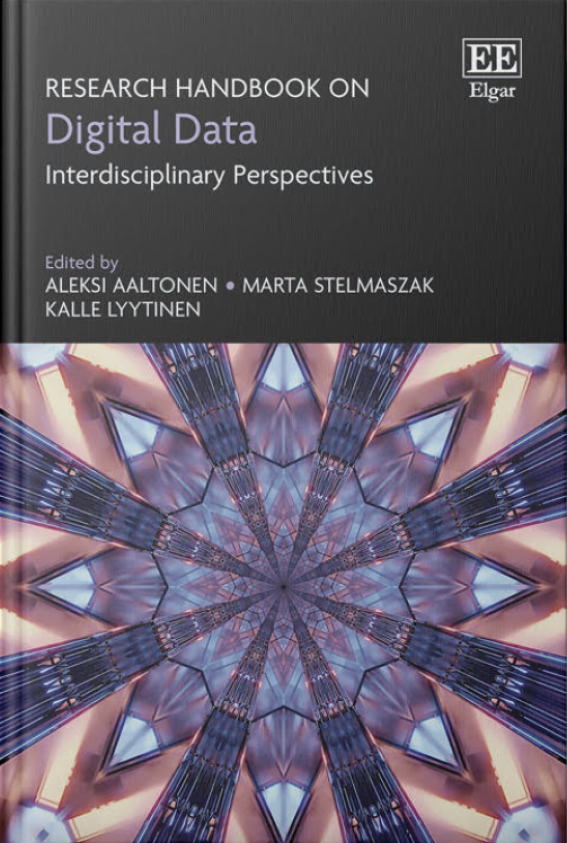
Digital data underpin everything from artificial intelligence and digital platforms to financial systems, healthcare, and government decision-making. Researchers who study data in areas such as sociology, computer science, public policy, and management are all asking important questions, but they often do so separately, said Marta Selmaszak Rosa, assistant professor of information systems in UMass Amherst’s Isenberg School of Management.
“There is surprisingly little dialogue across those fields,” she said. The need for a more integrated approach led her to work with two colleagues to develop the Research Handbook on Digital Data: Interdisciplinary Perspectives, which is being published this spring by Edward Elgar Publishing. “We felt there was a real opportunity to bring these perspectives together and create a space for interdisciplinary conversation and synthesis.”
In the new book, 53 researchers contributed to 24 chapters on foundation, design, practice, governance, and uses of digital data. The authors’ perspectives came from their own work in a range of disciplines across the social sciences, including information systems, management, organization studies, science and technology studies, sociology, economics, and urban geography.
“Each of these fields approaches digital data from a different angle,” Stelmaszak Rosa said, “whether focusing on technological infrastructures, organizational practices, governance, or societal consequences.”
The Digital Data Kaleidoscope
In 2024, Stelmaszak Rosa began discussing the project with Aleksi Aaltonen, associate professor of information systems at Stevens Institute of Technology, and Kalle Lyytinen, the Iris S. Wolstein professor of management design at Case Western Reserve University. The three editors wanted to create a resource for understanding the ways that digital data can change the nature of what they describe, rather than simply capturing reality.

If earlier forms of data functioned like telescopes (designed to bring something into clearer focus through measurement), then digital data instead behave like kaleidoscopes—they are “highly granular, continuously updated, and easily recombined across systems,” according to Stelmaszak Rosa. By that logic, the same underlying data can produce multiple representations of the phenomena they describe.
“For example, the digital data collected about a person—such as browsing history, location traces, purchase records, or health metrics—can be recombined to produce profiles,” she said. “Depending on how those data are assembled, they can produce very different images of the same person: perhaps as a reliable borrower, a high-risk insurance client, a desirable customer, or the target of personalized information.”
This affects that person’s life in numerous ways, she added. “Digital data shape organizations, markets, technologies, and societies, so no single field can fully capture their implications.”
A New Resource
The new handbook is designed primarily for researchers and doctoral students who study data and digital technologies in the social sciences, but it will also be useful for instructors teaching courses on data, analytics, and digital transformation, Stelmaszak Rosa said. Because the chapters bring together perspectives from a wide range of fields, the book can be used in graduate seminars and advanced courses across many disciplines.
She added that the insights in the handbook are relevant beyond academia: “Organizations, policymakers, and technology leaders are increasingly making decisions that depend on digital data. We hope the handbook will help readers better navigate the rapidly evolving data landscape and make more informed decisions about how data should be used and governed.”
Marta Stelmaszak Rosa’s research examines digital data in organizations, with a focus on their innovation, responsibility, and value. Her work has appeared, among other places, in MIS Quarterly, Information Systems Research, the Journal of the Association for Information Systems, and the Journal of Management Studies. She is a recipient of the Association for Information Systems Early Career Award. She holds a PhD from the London School of Economics in Political Science, as well as an MSc and an MSc in Data Science from Birkbeck, University of London. She co-leads the Data Studies Bibliography, an international community advancing scholarship on data as an object of inquiry.