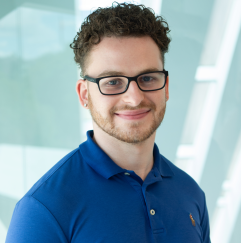
2026 Accounting Alumnus of the Year: Tim Grady ’93

As Tim Grady ’93 approached his senior year of high school, he wasn’t quite sure what he wanted to do after graduation. His mother—a high school business teacher—encouraged him to choose an accounting class as one of his 12th-grade electives, and he immediately recognized that this was something he could see himself doing long-term. He came to the Isenberg School of Management at UMass Amherst to study accounting as a college student, and after graduating, went to work as an associate at PwC, where he has worked his way up to assurance partner and the U.S. chief operating officer.
Grady returned to campus to accept the Accounting Alumnus of Year Award this past April. Before the event, he spent the day on campus meeting with faculty and students; in the afternoon, he shared his professional experiences and insights with students and accounting faculty in a “fireside chat” with Dr. Matthew Sherwood, associate professor of accounting.
“Lots of people think that accounting is boring,” Grady said during the fireside chat. “But I don’t see it that way at all. Accounting is the language of business, and from that first class in high school, I fell in love with the structure of the profession.”
Starting Strong
After graduating from Isenberg in 1993, Grady moved to Boston and joined Coopers & Lybrand, which later merged with Price Waterhouse in 1998 to form the PwC of today.
“I got to do a little bit of everything starting out, which was great because I still didn’t know exactly what I wanted to focus on within the profession,” Grady shared. “What I did know is that if I wanted to succeed, I had to challenge myself and put myself out there. When you join an organization, the more people you can meet, the better it’ll be.”
A couple of years into Grady’s career, after being promoted to senior associate, one of his friends from work came to him with what initially seemed like a crazy idea: what if they moved to London for a couple of years and worked out of that office? Grady took the leap, and he credits it as one of the best personal and professional decisions of his life.
“I ended up being promoted to manager within a year, and then not long after I returned from London, I made partner,” he said. “I don’t know if all of that would’ve been possible without the experience I gained from putting myself out there and pursuing this new opportunity.”
A People Business
In the years following his return from London, Grady focused on alternative asset management, working with some of PwC’s highest-profile clients in the field. “Working with these clients truly helped me understand that everything is a people business,” Grady said. “There were plenty of times when I felt like the dumbest guy in the room, but I took it as a learning experience and an opportunity to not only hone my business acumen but also build relationships and trust.”
One of the clearest examples of how this approach paid off came in 2008. Grady was on a plane from Boston to New York City, and unbeknownst to him, a significant event occurred contributing to a stock market crash and the climax of the subprime mortgage crisis. “I landed to about 100 calls from different people who were all understandably panicking,” he said. “One of those calls was from my client.” Grady went straight to their offices, where he was greeted by a boardroom full of senior leadership, all of whom were looking to him for direction on what to do so that the company could survive. “It was extremely daunting, but it actually ended up being one of the most interesting days of my career,” he said. “Because I had those relationships with everyone I worked with at the client, we were able to trust each other and help the company pull through.”

Isenberg’s Impact
Grady credits his four years at Isenberg with helping him develop those foundational people skills that have served him so well throughout his career. “One thing that’s special about the accounting curriculum at Isenberg is all the opportunities you get to team up with people and collaborate,” he said. “Like a lot of people, I never really liked doing group projects in the moment. But looking back, I see that I gained the most from that type of work.”
Bradley Bennett, Ronald C. Mannino Faculty Fellow and chair of the accounting department, spoke of Grady’s successful career at PwC and how he leveraged his UMass education and Isenberg degree in multiple leadership roles at PwC. “We’re so proud to be able to claim Tim Grady as one of our own,” Bennett said. “It’s inspiring for our students to see the trajectory of his career, knowing that he was at one time a student here in the same program as they are. As chief operating officer, he is leading PwC professionals into a new phase of the profession, with exciting technological opportunities and growth. We faculty are thankful for the time he has spent with our students and for the engagement he has had with the school and department over the years. He continues to support our students’ programs and mentor graduates as they enter the profession. It was truly an honor to present Tim with the Accounting Alumnus of the Year Award for 2026.”
When asked what advice he’d give to the students of today who are starting to think about what they want to do after college, Grady’s response was simple: “Go where you’re wanted and constantly look for opportunities for change and growth. It’s okay to fail, as long as you learn from it. But most importantly, as valuable as the technical skills you’ll learn in the classroom are, building relationships and interpersonal skills are really the most important factor if you want to succeed in anything you do.”