OIM Students Take on Real-World Analytics Challenge at 2026 Business Analytics Competition
During the spring semester, two undergraduate teams from the Operations and Information Management (OIM) program at the Isenberg School of Management represented UMass Amherst at the 2026 Business Analytics Competition—a demanding analytics challenge that combined technical rigor, fast-paced problem solving, and professional presentation skills.

Under the guidance of Ali Shirzadeh, PhD, an OIM lecturer serving as faculty advisor for the third consecutive year, the students prepared for the competition by spending months studying the case, which focused on automotive recalls. They had the opportunity to work with a rich real-world dataset spanning more than a decade of recall records.
Teams explored patterns in recall severity, defect categories, manufacturer risk profiles, and stock-market responses to recall announcements. Their work required them to develop a complete analytical framework, ranging from data preparation and feature engineering to machine learning, clustering, event-study analysis of financial market reactions, and business interpretation.

“This competition presents students with a new and challenging business problem, creating an opportunity for them to apply their analytical skills in ways that go far beyond the boundaries of a typical classroom project,” said Shirzadeh.
The semester-long preparation culminated in the first stage of the competition, where teams presented research posters summarizing their analytical findings and recommendations.
The challenge intensified during the in-person competition at Manhattan University, where students faced a new analytical case component under strict time pressure. Within just 12 hours, they analyzed additional questions, developed fresh insights, created presentation materials, and prepared to present their findings to a panel of industry judges.
The experience demanded not only strong analytical skills, but also teamwork, adaptability, and the ability to communicate complex findings clearly under pressure.
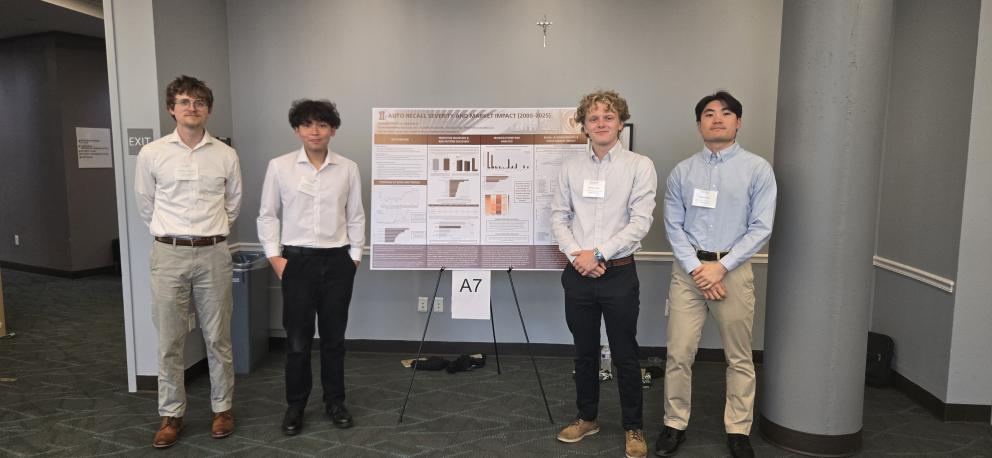
“What stood out most this year was how quickly the teams embraced the challenge,” Shirzadeh said. “They moved from initial uncertainty of ‘where do we even start?’ to building thoughtful analytical workflows, uncovering meaningful insights, and telling a compelling data-driven story.” He adds that the students practiced technical skills as well: cleaning and structuring complex data, identifying hidden patterns, developing risk profiles, and connecting findings to real financial outcomes.
“More importantly, they learned how to make decisions when the data was imperfect, assumptions needed to be challenged, and multiple paths forward were possible,” Shirzadeh added.
Both Isenberg teams rose to that challenge with professionalism and confidence, delivering polished presentations and demonstrating impressive technical depth throughout the event. Their work reflected the strength of experiential learning in Isenberg’s OIM program and showcased the power of applying business analytics to real-world challenges.
Team Members
• Team 1: Zijian Wu, Sanvee Gupta, Bach Nguyen, Andreas Burgess
• Team 2: Harrison Mayer, Leo Nguyen, Preston Sanderville, Micheal Wu