Isenberg Researchers Explore Robotic Guide Dog Technology for Accessible Tourism
For many independent travelers who are blind or have low vision, visiting unfamiliar destinations can be stressful, exhausting, and difficult to navigate without help. Researchers from the UMass Amherst Isenberg School of Management’s Department of Hospitality and Tourism Management (HTM) hope to change that through a new project that explores robotic guide dog technology.

HTM Assistant Professor Jennifer (Jiyoon) Han, PhD, leads the project as principal investigator, working with HTM graduate researcher Seungho Kim. They are collaborating with researchers from computer science, robotics, human-computer interaction (HCI), and design to examine how emerging technologies can improve accessibility for travelers.
Their project, “Designing a Robotic Guide Dog for Inclusive Tourism,” will focus on Boston’s Freedom Trail, exploring whether a robotic guide dog system can help visitors who are blind or have low vision navigate historic sites more independently while creating a safer, more accessible, and more welcoming visitor experience.
At the heart of the project is the development of a robotic mobility assistant. To ensure the technology meets real-world needs, UMass Amherst robotics researchers (from the Manning College of Information and Computer Science) are working with guide dog users and trainers, using their feedback to shape how the robotic guide dog navigates, interacts with users, and helps them in unfamiliar environments.
The interdisciplinary team recently received one of four $15,000 seed grants awarded through the UMass Amherst Institute of Diversity Sciences (IDS) annual competition. The grants support STEM (science, technology, engineering, and mathematics) research that addresses social challenges and advances the public interest. This year’s funded projects represent faculty and students from nine academic departments across campus.
“Receiving this IDS seed grant is deeply meaningful to me,” said Han. “Our team brings together expertise spanning hospitality and tourism management, business, computer science, robotics, and human-computer interaction and design, creating a truly interdisciplinary collaboration.”
IDS grants have historically been awarded to STEM disciplines; Han said the recognition also highlights the role that business and hospitality researchers can play in addressing complex societal challenges through interdisciplinary collaboration.
“As an Isenberg faculty member, I am especially proud to demonstrate how business scholarship can contribute valuable perspectives to STEM-focused research,” she said. “Because IDS grants are awarded through a highly competitive process, I am honored to receive this recognition as a faculty member in the Isenberg School of Management.”
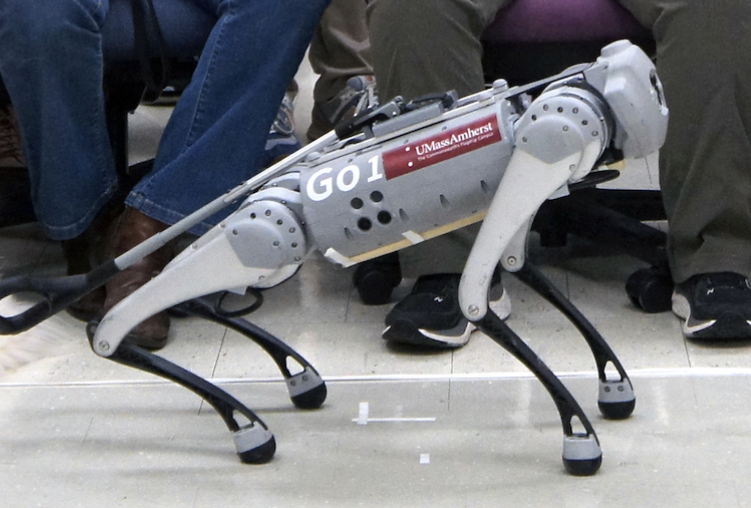
The research team’s goal is to create more accessible and memorable travel experiences for people who are blind or have low vision by combining customer experience design with emerging assistive technologies.
“Our research aims to reduce barriers by developing a robotic guide dog system integrated with GPS, artificial intelligence, and other assistive technologies to support safe, engaging, and less stressful travel experiences,” said Han. “Using customer experience design principles—such as mapping and touchpoint analysis—we begin by identifying key moments where support can make the greatest difference for blind and low-vision travelers. We’ll take a human-centered, inclusive design approach to understand the emotional, physical, and cognitive challenges that blind and low-vision travelers may face. By examining these experiences from the travelers’ perspective, we can determine opportunities to provide support and improve accessibility at the moments that matter most.”
Han hopes the research will “contribute to a future in which people who are blind or have low vision can participate more fully and confidently in a range of activities, helping to make hospitality, tourism, and public spaces more inclusive for everyone,” she said. “We also see this grant as an important foundation for future work and a stepping stone toward larger externally funded opportunities, including federal grants.”
Hands-on Learning for Isenberg Students
The project will also provide hands-on learning opportunities for Isenberg undergraduate and graduate students, according to Han. Students will participate in research activities, gain experience with emerging technologies such as robotic guide dogs and assistive systems, and develop an understanding of customer experience design and inclusive tourism.
“As one of the primary goals of the IDS program is to support students and provide training and professional development opportunities, this project will offer Isenberg students valuable exposure to an innovative interdisciplinary research initiative,” said Han.
The IDS established its annual seed grant program to encourage interdisciplinary collaborations that address issues affecting communities.
“At a time when so much about higher education feels uncertain, it’s easy to focus on what we can’t control,” said IDS Director Nilanjana (Buju) Dasgupta. “Our seed grants reflect what we can do—bring together faculty and students from different disciplines to develop research that responds to the needs of our communities. These projects demonstrate how scientific collaboration can create meaningful impact.”
