Isenberg Expands Access to Internship Experiences Through Three Career Success Programs
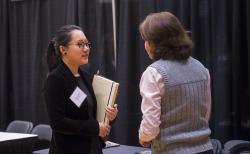
Isenberg Office of Career Success initiatives help students gain hands-on experience, build confidence, and prepare for a competitive job market.
At the Isenberg School of Management at UMass Amherst, career preparation begins well before students start applying for full-time jobs. Recognizing that today’s undergraduates are entering a challenging and competitive job market, the Isenberg Office of Career Success (OCS) takes a holistic, four-year approach, working with students from their first year through graduation.
Three new internship-focused programs have been rolled out over the past academic year with a goal of reducing barriers, expanding access, and connecting students with real-world experience: the Isenberg OCS Internship Fund, micro-internships, and the Nonprofit and Small Business Internship Program.

“We read the headlines and know it’s a difficult job market, so we’re giving Isenberg students a leg up,” said Holly Lawrence, assistant dean for Isenberg’s Office of Career Success. “We’ve been working hard with funders, recruiters, and local businesses to create more opportunities for Isenberg students to have these important work experiences and to broaden their networks with local and regional employers and friends of the school.”
Students who have at least one internship on their resume are much more likely to secure a full-time job within three months of graduation than those who don’t, according to Lawrence. Research from the National Association of Colleges and Employers (NACE) has also linked experiential learning, including internships, with stronger post-graduation outcomes.
Making Internships More Accessible
The new Isenberg OCS Internship Fund provides financial awards of $1,000 to $5,000 to undergraduate students who have secured summer internships but can’t afford to accept them without support because of expenses such as travel, housing, relocation, or commuting in high-cost locations like Boston or New York City—especially in cases where internships offer little or no compensation. The stipends are supported by alumni donors.
“The OCS Internship Fund reflects the incredible commitment of Isenberg alumni donors to supporting the next generation of business leaders,” said Melissa Salva, executive director of undergraduate employer relations and operations in Isenberg’s OCS. “Their generosity helps students access internships that might otherwise feel out of reach. That support can make a real difference in a student’s ability to move closer to their career goals.”
For students awarded stipends, the support can make an immediate difference. As one student shared in an anonymous survey, “Support from the Isenberg community has made a huge impact on the opportunities that I’ve been able to pursue.” Another student wrote that the funding would ease the financial pressure of accepting an internship: “This support will help me focus more on my internship and take a lot of stress off my family and me.”
Micro-internships Open Doors to Real-world Experiences
OCS also introduced a micro-internship program this academic year, in partnership with the online platform Parker Dewey, to give sophomores and juniors more opportunities to build experience earlier in their academic careers.
Students are matched with short-term, virtual projects created by employers. Projects typically require 20–40 hours of work and are designed to be clearly scoped, giving students practical experience while helping employers complete business projects.
A pilot cohort of 22 Isenberg sophomores and juniors participated during winter break in January, helping OCS prepare for a larger summer program. OCS will continue evaluating how the program runs in the future, including whether micro-internships could be offered at additional points throughout the academic year.
“We see micro-internships as a way to create more of these opportunities for our students while also providing value to employers,” said Lauren Casaceli Abad, associate director of career development in Isenberg’s OCS.
The program strengthens the broader Isenberg community by connecting students, alumni, and employers, according to Salva. A few alumni also served as project sponsors for micro-internships, giving students the opportunity to work directly with Isenberg graduates.
“Micro-internships are a strategic win for our entire Isenberg community,” said Salva. “They help students gain practical experience in an accessible way, engage alumni and employers in student career development, and introduce new employers to the strength of our talent pipeline.”
This summer, a larger micro-internship cohort is working across a range of industries. Participating employers include Mass General Brigham, Quest Diagnostics, Charles River Labs, Hub International, Connelly Partners, Meet Boston, Massachusetts Small Business Development Center, UMassFive College Federal Credit Union, Perigon Wealth, Amel Energy, Greenfield Cooperative Bank, and Conning Investments.
Students work on projects such as financial insight analyses, user experience testing, media performance and conversation forecasting, and market landscape analysis. Each project includes at least three touchpoints with the employer, giving students opportunities to practice professional communication, ask questions, provide updates, and present their work.

Emma Siegel, a sophomore marketing major, completed a micro-internship during winter break with UMassFive, where she led a competitive analysis of social media strategy across the Pioneer Valley. She evaluated how credit unions, banks, and fintech companies engage audiences on Facebook, Instagram, and LinkedIn, analyzing content, engagement, branding, and community partnerships. She then translated those insights into recommendations to strengthen UMassFive’s social media presence and differentiation.
“This micro-internship pushed me outside the industry I originally thought I’d be interested in, and I’m really grateful for that,” said Siegel. “It helped me realize that marketing is less about a specific industry and more about the strategy, creativity, and problem-solving behind the work. Being able to apply what I’ve learned in courses to a real marketing project has made everything feel a lot more real.”
Cole Arbisi, a sophomore accounting major, also found the experience valuable. Through a micro-internship with Massachusetts Health Quality Partners, he participated in meetings with the CEO and COO, conducted research on healthcare-related companies in Boston, and provided insights to staff.
“I’m extremely grateful for the opportunity and recommend anyone who wants real-world, industry-specific experience to apply,” said Arbisi.
The program also benefits employers. Craig Boivin ’22MBA, vice president of marketing at UMassFive, created the project Siegel completed and said the experience brought value to his team.
“As a small but mighty marketing department, thoughtful resource allocation is always essential,” he said. “Participating in the Isenberg micro-internship program provided real value to the credit union, expanding our marketing team’s capacity, bringing in fresh perspective from a younger demographic, and, as a UMass alumnus, giving me the opportunity to reconnect with Isenberg while mentoring the next generation of marketers.”
Supporting Students and the Local Community
Through the Nonprofit and Small Business Internship Program, Isenberg is also helping students gain business experience while supporting organizations in the Pioneer Valley.
This summer, Isenberg has partnered with Amherst-area nonprofit organizations and small businesses to provide internships that allow students to apply their business knowledge while contributing to the local community. OCS works with participating organizations (including Amherst Business Improvement District, Cancer Connection, Community Legal Aid, Franklin County YMCA, Friends of Children, Friends of the Jones Library System, Stone Soup Café, The Closet, The Conway School of Landscape Design, and Valley Community Development) to promote 10-week summer internships typically consisting of about 20 hours of work per week.
With financial support from alumni donors, Isenberg can offer students a stipend to supplement a low-paying internship with a nonprofit or small business so they can earn approximately $20 per hour.
“The Nonprofit and Small Business Internship Program reflects the power of Isenberg alumni support and community partnership,” said Salva. “Students gain relevant, practical professional experience while helping nonprofits and small businesses that may not otherwise have resources to fund an intern.”
In the News
Casaceli Abad recently spoke with Western Mass News about how OCS helps students strengthen their interview skills and gain real-world experience, including through Isenberg’s micro-internship program.
