Charting the Quantum Frontier: Connor Casey ’26
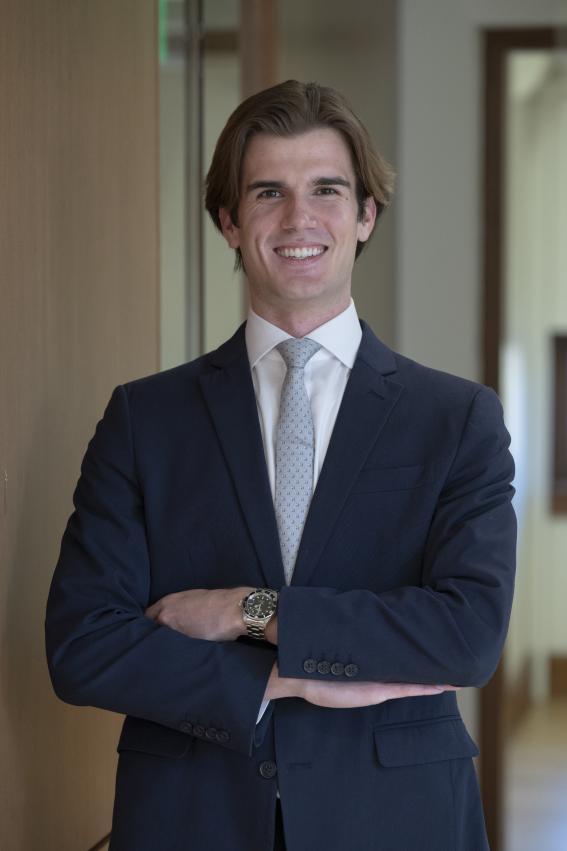
For finance major Connor Casey '26, being an undergraduate has meant exploring—and helping shape—emerging fields at the intersection of science, technology, and entrepreneurship.
Alongside his finance major, he's also earning degrees in applied physics and quantum science and engineering (BDIC), as well as minors in mathematics and philosophy. During his time at UMass Amherst, he has conducted research in quantum science, satellite communications, and deep-tech venture building.
“Quantum science opened up a new universe,” said Casey. “I realized that I wanted to explore every corner of it.”
Alongside his classwork and research, his academic journey has included work on entrepreneurial ideas including Aeromind, an emerging deep-tech venture built around intelligent drone systems, which he pursued with support from the Berthiaume Center for Entrepreneurship. “Connor has been so ambitious in pursuing academics and experiences that allow him to connect his business skills and knowledge with his interest in science and engineering,” said Gregory Thomas ‘91, Berthiaume’s executive director and lecturer in the Isenberg School of Management, who has served as a faculty mentor to Casey. “The business innovation he brought to Berthiaume’s boot camps and competitions demonstrates his ability to translate his very complex technical skills to a viable enterprise.”
Research Success Across Disciplines
During his time at UMass, Casey has contributed substantive research efforts tackling problems ranging from quantum error correction to satellite-based entanglement distribution. He has worked with Don Towsley, director of the Quantum Information Systems Institute in the Manning College of Information and Computer Sciences (CICS), Chen Wang, associate professor in physics, Filip Rozpedek, assistant professor in Manning CICS, and Albert Williams, a PhD student in Manning CICS.
In 2025, he presented a first-author poster at the IEEE International Conference on Quantum Computing and Engineering as well as serving as first author on a paper presented at the 76th International Astronautical Congress (IAC) in Sydney. Casey has worked alongside leading scientists from UC Santa Barbara and University College London.
Casey’s business background has also given him a unique point of view and strategic advantage in the overall research landscape.
“I find myself thinking about the research ecosystem not only through a technical lens, but also through the more practical lens of incentives, funding, and adoption,” Casey shared.
He’s also been able to take advantage of skills and opportunities from the finance world to enhance his research, from building high-quality presentation materials to taking advantage of Isenberg’s extensive networking opportunities to build collaborations with researchers across the world. “My finance experience gives me a practical lens for how innovation becomes something real,” Casey said.
Academically, he had a strong ally in Isenberg’s assistant dean for academic advising, Shelby Prizio. “She’s truly been the person in my corner, whether I’ve just needed a credit override, or wanted to talk to someone about my rather ambitious plans,” Casey said. “She always looks for a reason to say yes where others might just say no.”
Thinking Beyond the Lab
If Casey’s research represents his depth, his entrepreneurial work showcases his range: His company, Aeromind, recently won a hackathon, which earned it a feature in TechCrunch, giving the fledgling startup early visibility in the autonomy and robotics ecosystem.
“I see a business background as an incredible complement to a technical one,” Casey said. Through his internships at Morgan Stanley’s Technology Investment Banking Group and General Atlantic’s investment team, he has acquired firsthand knowledge of how transformative technologies scale, gain funding, and enter global markets.
“As I became more interested in startups and venture capital, I kept noticing a pattern of a venture having two co-founders—one from a technical background, like computer science or math, and one from a business background, like investment banking or private equity,” Casey said. “But I never felt that those roles had to be disjointed or separate for me. I love both disciplines.” In a future where quantum technologies, satellite networks, and intelligent systems come together, leaders like Casey will play a crucial role in bridging the gap between scientific advancements and their acceptance in society.
“When I first started thinking about my post-graduation plans, I was torn between going all-in on the pure business path, like moving to Silicon Valley and pursuing venture capital, or taking a different route,” Casey said. “Given how many investors have never actually built a startup, I felt I would be doing myself a disservice by treating venture as my end goal. Instead, the more exciting path for me is to go as deep as possible into a technical field I genuinely care about and build real credibility and problem-solving skills, because that is the skill set I will ultimately need as a founder.”
Cultivating the Next Generation of Quantum Talent
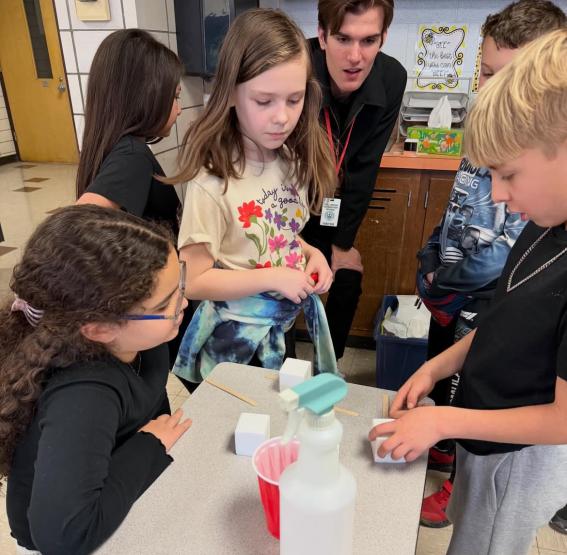
Equally impactful is Casey’s work in community-building. He is the founder and president of the Amherst Quantum Initiative (AQI), a cross-university organization uniting students from UMass Amherst and Amherst College in physics, engineering, and computer science. AQI has created a peer-led quantum information curriculum, launched collaborative research groups, and built a K-12 outreach program that brings hands-on quantum demonstrations into local classrooms.
In a field often criticized for its lack of transparency, Casey is determined to broaden access. “Quantum shouldn’t be a closed door,” he says. “The more minds thinking about it, the faster we move towards the breakthroughs that matter.”